
Direct answer
An industrial GAC system is designed around a treatment target and a breakthrough-control strategy, not around media mass alone. Empty-bed contact time, or EBCT, relates the nominal empty bed volume to flow, but it is only one design input. Bed depth, loading rate, water chemistry, competing organic matter, temperature, particle control, flow distribution and the selected carbon all affect operation. The design also needs pressure limits, sampling points, a defined outlet trigger, backwash or fines-management provisions, and a replacement or regeneration plan. Yuchen Water can supply activated-carbon materials and provide equipment technical support after the report, hydraulic duty and monitoring requirements are reviewed.
Start with the buyer's problem
The buyer may know the required flow but not the contaminant loading or target endpoint. In that case, vessel sizing cannot establish media life. Another project may have detailed chemistry but no information about peak flow, duty cycle or available pressure. Both gaps matter. The technical brief must combine water quality, hydraulics and operations so the system is not sized for an average condition that disappears during peak demand or seasonal change.
Breakthrough is not synonymous with complete exhaustion. It is the point at which a monitored compound or surrogate reaches the project-defined trigger. That trigger can be set before a compliance or process limit to provide operating margin. Different compounds can break through at different times, and natural organic matter can occupy adsorption capacity. The project should state what will be measured, where samples will be taken, how often they will be analyzed and what action follows a result.
What report and operating data are required
Industrial review requires a representative chemistry profile and a hydraulic operating envelope. A single TDS result cannot define adsorption duty or vessel behavior.
- target compounds, inlet range, outlet target and analytical method
- TOC or COD, natural organic matter indicators and competing compounds
- pH, temperature, turbidity, suspended solids and biological context
- average, minimum and peak flow with daily runtime and flow variation
- available pressure, allowable pressure loss and downstream requirements
- planned vessel diameter, bed depth, bed volume and distributor concept if known
- sampling locations, frequency, breakthrough trigger and response time
- media changeout, regeneration, backwash, drainage and spent-media plan
A report should be recent enough to represent the proposed source and should identify the sample date and location. If the water changes by season, production batch or operating state, provide the range rather than one convenient result. State the required treated-water objective separately from the current analysis. When a value is unknown, mark it as unknown; a visible gap is safer than a guessed number.
Hydraulic information belongs beside chemistry. Average flow alone can hide short peak conditions, intermittent duty and long stagnation. Confirm daily runtime, peak demand, available pressure, allowable pressure loss, equipment dimensions and who will monitor and replace the carbon. These details decide whether an otherwise plausible media can be used in a serviceable system.
Selection logic
Calculate nominal EBCT from the proposed empty bed volume and operating flow, then test whether the full hydraulic range preserves the intended design basis. Do not publish one EBCT as a universal requirement for all contaminants. The value must be supported by relevant evidence, pilot work, supplier guidance or a qualified process design. Peak flow, parallel operation and out-of-service vessels can materially change the available contact.
Review flow distribution next. Poor distributors, uneven loading, trapped air or bed disturbance can create preferential paths that shorten effective contact. Bed depth and vessel geometry must work with the selected particle size, retention screens and backwash strategy. Pressure gauges or transmitters across the vessel provide an operating signal, but pressure loss alone does not reveal adsorption breakthrough.
Choose the monitoring and vessel sequence together. Lead-lag vessels can provide a polishing barrier and allow the operating positions to be rotated after the lead bed reaches its trigger. Parallel vessels may serve flow capacity but need balanced distribution and a sampling strategy for each train. The arrangement should reflect continuity requirements, analytical turnaround, media service access and the consequence of exceeding the outlet target.
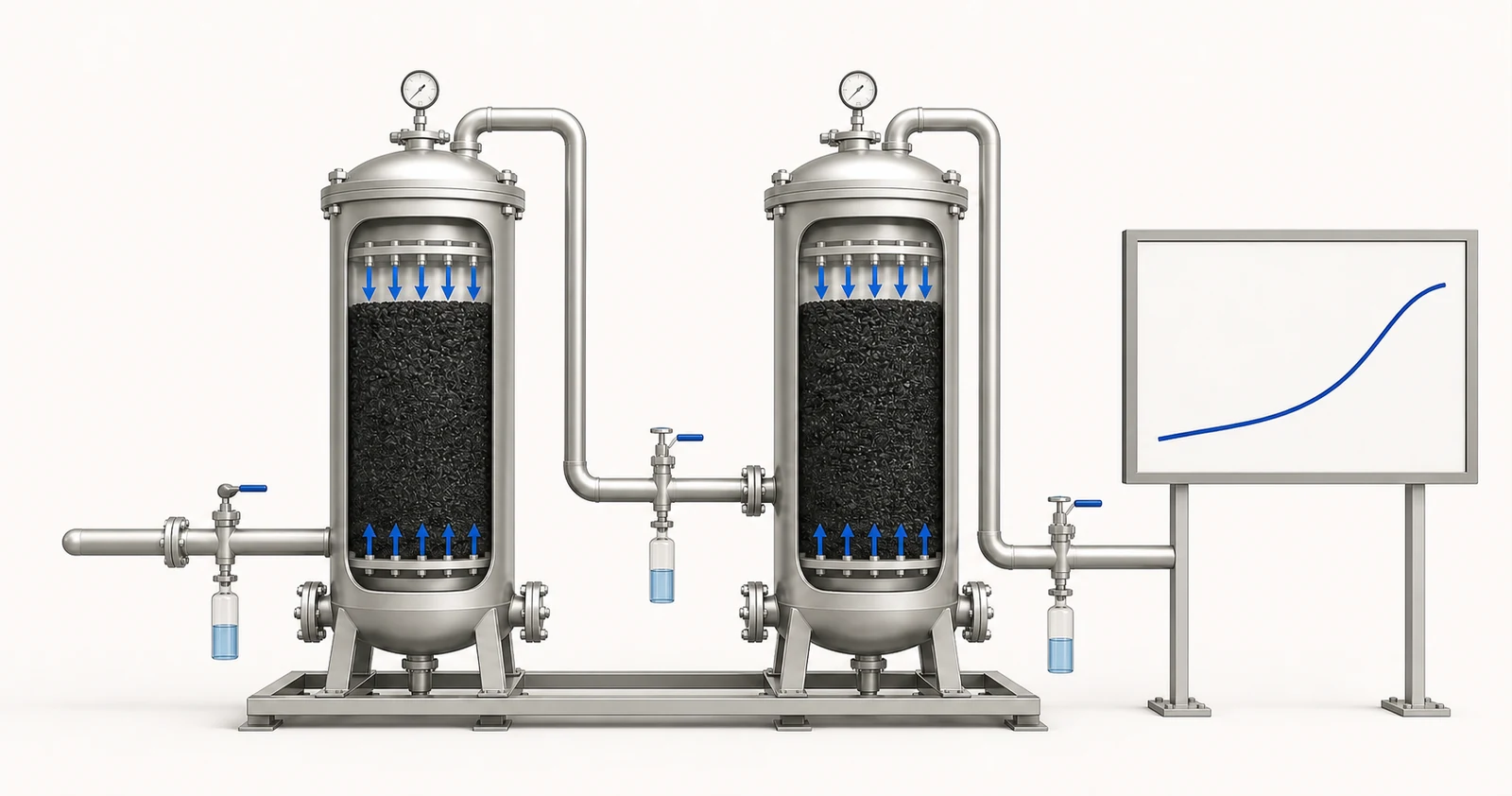
- Lead contactor
- Interstage sample point
- Lag contactor
- Outlet sample point
- Conceptual breakthrough trend
Conceptual illustration. Not test results, product certification or an engineering drawing.
Pretreatment, equipment and operating context
Pretreatment protects hydraulic and adsorption performance. Solids control can reduce fouling and channel formation, while upstream chemistry may need adjustment for a target process. If oxidants or biological growth are relevant, the design must address them explicitly. Backwash water quality, flow and disposal also need review; a backwash provision has no value if the site cannot supply the required hydraulic condition.
Commissioning should document media identity, loaded quantity, bed depth, initial flushing, baseline pressure and initial analytical results. Operations should trend flow, pressure, sampling results and service events. Replacement planning should include media availability, vessel isolation, safe handling and verification after return to service. Yuchen Water can support material documentation, supply and equipment questions within this defined scope.
Common mistakes
- Treating EBCT as the only sizing rule
- Predicting media life from kilograms of carbon without contaminant loading
- Using pressure drop as a substitute for breakthrough testing
- Omitting peak flow, vessel outage and analytical turnaround from the design
- Providing no sampling point or action level before the outlet limit
Evidence and service boundary
A preliminary vessel concept can identify information gaps and possible arrangements, but it is not a guaranteed performance design. Capacity projections require application-relevant evidence and assumptions that are visible to the buyer. Where uncertainty is material, bench or pilot testing and a conservative monitoring plan may be appropriate before a final commercial commitment.
Yuchen Water's role is activated-carbon material supply plus related vessel, filtration and equipment technical support. Site engineering, local compliance, process safety and final operating acceptance remain project-specific. No published page should promise a universal EBCT, bed life, removal percentage or changeout interval without an approved, documented basis.
Yuchen Water reviews the target and evidence first, then identifies the appropriate carbon format and material questions, supporting pretreatment and equipment needs, and the documents or tests still required. The output can be a preliminary direction, a request for missing information, or a supportable material and equipment recommendation. A recommendation is not released simply because a buyer supplied a product name.
After supply, technical support can cover document confirmation, installation and flushing questions, remote commissioning guidance, monitoring points and replacement planning within the agreed scope. Actual performance still depends on the approved material, complete equipment, source water, installation, operation and maintenance. Published guidance cannot replace the project review.
No final material, capacity, service life, removal percentage or project result is promised before the report, construction, evidence and operating conditions are reviewed.
Official technical sources
These sources explain treatment principles or certification boundaries. They do not certify Yuchen Water products and do not replace project-specific evidence.
Related activated-carbon guidance
Continue through the knowledge cluster, review selected sample evidence only within its stated limits, compare product formats, or submit the report for a technical review.